
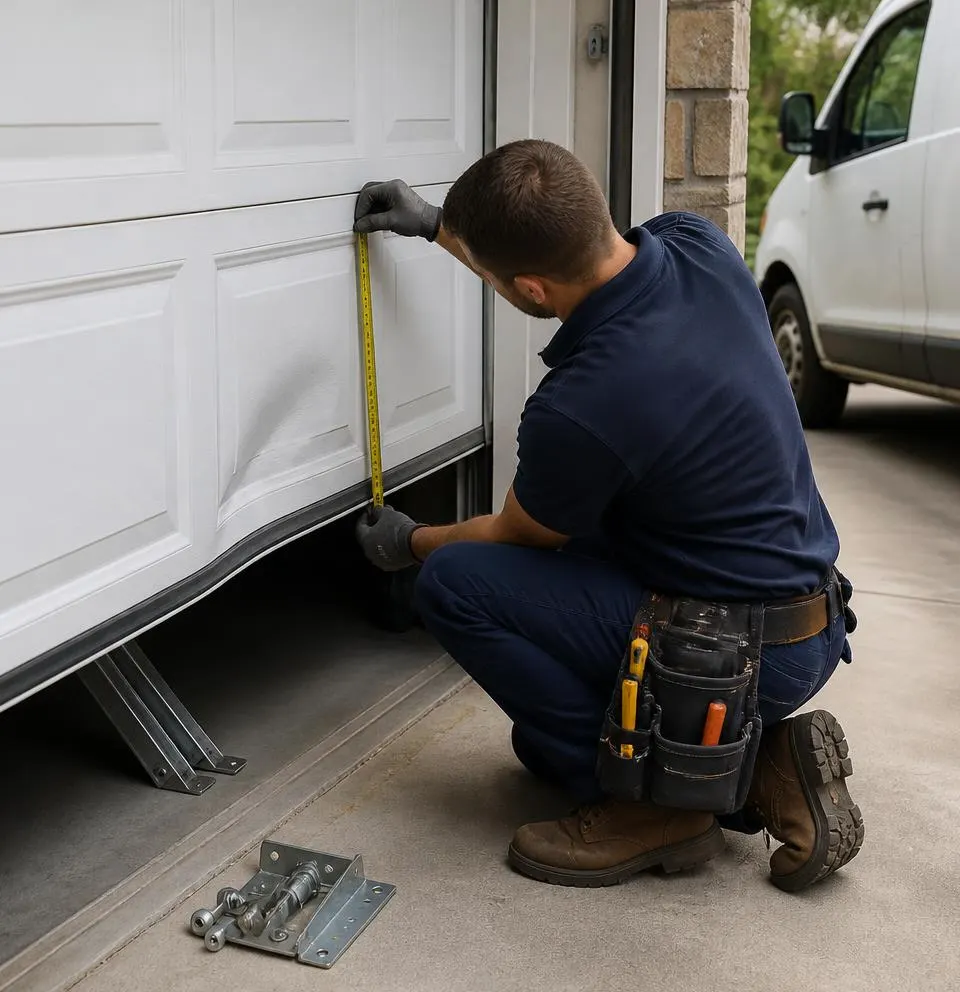
You press the remote on your way out the door, or thumb the wall button after pulling into the driveway, and nothing happens. Maybe the opener hums but the door doesn't move. Maybe there's dead silence. Maybe the door starts up, reverses halfway, and shuts itself again. Whatever the exact moment looks like, you're now standing in the garage wondering if this is a five-minute fix or a service call.
The good news: a stuck garage door almost always has a findable cause, and most technicians work through the same checklist in the same order — cheapest and fastest possibilities first, mechanical failures last.
The Symptoms, Sorted
Before any tools come out, it helps to know which category you're in:
- Total silence — no motor sound, no light, nothing when you press the button.
- Motor runs, door doesn't move — you hear humming or grinding, but the door stays put.
- Door moves partway, then stops or reverses — it starts to lift, then drops back down or won't go further.
- Door won't budge even by hand — you've pulled the emergency release cord and it's still immovable or dangerously heavy.
Each of these points toward a different part of the checklist below.
The Order a Technician Checks
1. Power to the Opener
This sounds obvious, but it's the first thing checked because it's the most common and the cheapest to fix. Outlets in garages are often on GFCI circuits that trip from humidity or a power blip — not unusual after a rainy stretch once winter weather moves into the foothills. A technician checks the outlet, the breaker, and whether the opener's light is on at all before touching anything else.
2. Remote and Wall Control
Dead batteries in the remote, a remote that's lost its programming after a power outage, or a wall button with a frayed wire are next. This is also where dust gets blamed unfairly — a dirty remote button or corroded battery contacts can mimic a much bigger problem. A quick swap of batteries or a reprogram of the remote rules this out fast.
3. Safety Sensors (Photo Eyes)
If the opener runs but the door won't close, or closes partway and reverses, the two small sensors near the bottom of the tracks are usually next on the list. These infrared eyes have to be aligned and unobstructed, or the opener assumes something's in the way and refuses to finish the cycle. Dust buildup from dry-season wind, cobwebs, or even a shifted bracket can throw them off. The fix is usually realignment and a wipe-down — no parts needed.
4. The Manual Disconnect
Every opener has a red emergency release cord that disconnects the door from the trolley so it can be opened by hand during a power outage. If that cord has been pulled — sometimes by a curious kid, sometimes by accident while reaching for something stored nearby — the opener will run without moving the door at all. Reconnecting it is quick once a technician spots it.
5. Springs
If the door won't move even when the opener is disconnected and someone tries to lift it by hand, the springs are the next suspect. Torsion or extension springs counterbalance the door's full weight, and a broken spring makes a standard garage door — often well over a hundred pounds — nearly impossible to lift manually. This is where symptoms turn serious rather than just inconvenient, and it's not a DIY repair: broken springs are under heavy tension and have caused real injuries when handled without the right tools.
6. Cables and Track Alignment
A cable that's slipped off its drum, a bent track, or a roller that's jumped the rail can jam the door at an angle, making it look like a spring problem even when the springs are intact. A technician checks for visible gaps, kinks, or a door hanging crooked in its frame before assuming it's a spring issue.
7. The Opener's Internal Gear
Last on the list because it's the least common: a stripped plastic gear inside the opener unit itself. This usually shows up as that telltale humming-but-not-moving sound, paired with the chain or belt not advancing at all. It's a wear-and-tear issue more than a weather one, though openers that have run for years in a garage exposed to summer heat swings tend to show their age here first.
When to Call Friant Garage Door
Dead batteries and dusty sensors are fine to handle yourself. Anything involving springs, cables, or a door that's genuinely stuck under tension is not — that's where a call to Friant Garage Door makes sense. We run through this same checklist on-site, starting with the quick stuff and working toward spring replacement or opener repair only if that's actually what's needed. If it turns out to be the springs, we carry replacements built for standard residential doors and handle the install safely, with the right bars and clamps for the tension involved. If it's the opener itself, our garage door opener repair and installation service covers everything from reprogramming to a full unit swap.
If your garage door in Friant, Clovis, Prather, or anywhere else in the Fresno County foothills won't open, give us a call before forcing it by hand. We'll find the real cause and fix it the first time.